Dieudonné & Lorette: From Amsterdam to Rwanda
One of bBlyde’s most important partnerships is with Dieudonné Gakire in Rwanda. He works to create more opportunities for children and young people in Dusego, the village where he grew up.
.webp)

bBlyde Foundation is where we create room for positive impact beyond our day-to-day client work. We support projects that help create more equal opportunities, especially for children and young people. For us, that’s about more than education. It’s also about confidence, movement, spending time outdoors, and feeling connected to other people, as well as to the nature and environment around you.
That ambition is built into the way we run Blyde Benelux. Every year, €20,000 goes to the bBlyde Foundation, regardless of our profit. On top of that, we contribute through the 1% Pledge movement, together with our clients. And anything we earn above our agreed profit cap goes straight to the Foundation too.
One of bBlyde’s most important partnerships is with Dieudonné Gakire in Rwanda. He works to create more opportunities for children and young people in Dusego, the village where he grew up. Today, Dusego is home to The Empowerment Hub, with spaces for learning, meeting others and sports.
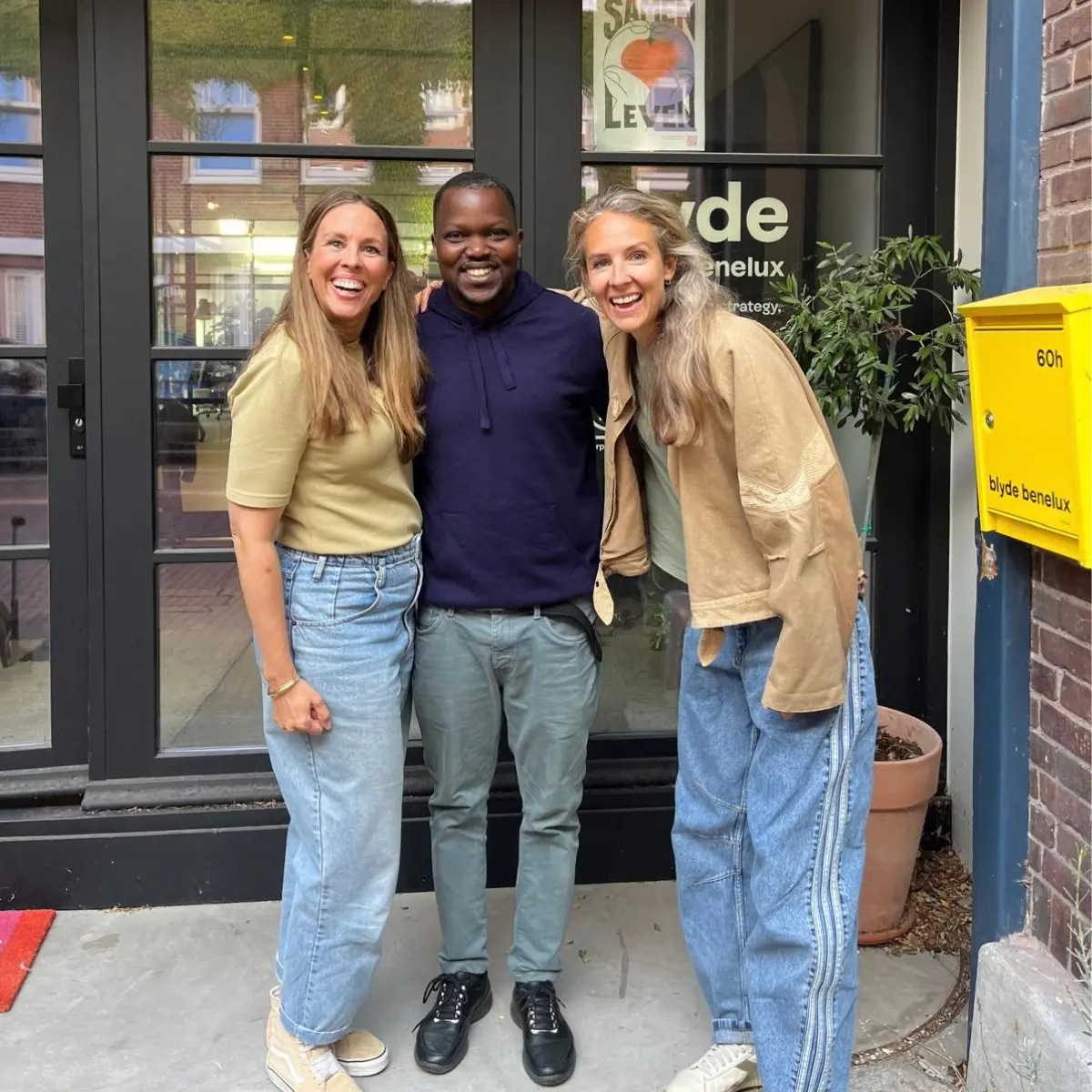
Lorette and Dieudonné first met through Net4Kids in Amsterdam several years ago. They started working together around Dieudonné’s dreams for Dusego, and along the way a close friendship grew too.
Three years ago, Lorette travelled to Rwanda. She attended Dieudonné’s wedding, met his family and friends, and visited Dusego, including the site where The Empowerment Hub would soon be built. Back then, there wasn’t a building yet. Today, that dream has very much become reality. The Hub is up and running, with space to learn, meet, play sports and spend time together.
So we thought it was a good moment to bring Dieudonné and Lorette together and talk about how it all started, what’s there today, and what Dieudonné still hopes to build from here.
Let’s start with three questions for Lorette. When you first met Dieudonné through Net4Kids, what was it about him and his plans for Dusego that stayed with you?
I can still remember it like it was yesterday. We were sitting together in the basement of our Blyde office on the Singel in Amsterdam. Dieudonné was incredibly open. He told ynke and me çabout Rwanda’s horrific history and about what he and his family had been through. Hearing that directly from him really hit me.
But at the same time, I immediately felt his strength and this huge drive to do something for his country and for Dusego. He had this dream of giving children and young people from the village where he grew up more opportunities, a chance to develop themselves, build confidence and grow up feeling more connected to the people around them.
You already knew his story and his plans really well. What did you only fully understand once you were actually in Rwanda and Dusego?
Just how different it is when you’re actually there. I knew his story, I’d read his book, and during the years he was studying in the Netherlands we talked a lot, often while walking around the canals in Amsterdam. But once I was in Rwanda, so many things suddenly fell into place.
I met his wife, his family and his friends. I saw where he came from and stood on the actual spot where the Hub was going to be built. I also saw a different side of Dieudonné. In Amsterdam he could be quite quiet, but in Rwanda he was completely in his element: happy, proud, full of ideas and with an incredible amount of energy.
Being at his wedding was really special for me. Meeting the people closest to him and being a small part of his life there, even just for a short time, helped me understand him and his background so much better.
Three years later, the Hub is actually there and children are using it. What does that feel like when you think back to that first visit to Dusego?
A lot, actually. When I was there three years ago, not a single brick had been laid yet. I remember thinking: okay, there’s still quite a bit of work to do here.
During lunch at his parents’ home, his father said something to Dieudonné in Kinyarwanda about getting started with the building before the rainy season arrived. I had no idea what was being said, but it was clearly one of those father-son moments. Dieudonné told me afterwards what he’d said, with a big smile.
His father passed away in March 2024. I still think back to that lunch at his parents’ home sometimes. It makes me think about how proud he would have been to see what stands there today and what Dieudonné has created for the community.
There’s now a wonderful Hub where children can learn, play sports and simply spend time together. Seeing that come to life feels incredibly special. What stands out most is how much Dieudonné, together with the community in Dusego, has been able to set in motion.
And at the same time, I also think: this is only the beginning. There’s already so much there, but Dieudonné still has so many ideas. He’s definitely not done yet. I think the Hub will become a place where more and more children and young people get the chance to discover new things, grow, and access opportunities that simply weren’t available to them before.
And now, over to Dieudonné. How does he look back on how it all started, what’s been built since, and what comes next for the Hub?
You and Lorette first met through Net4Kids in Amsterdam and started working together around your plans for Dusego. What do you remember most about those first conversations?
I still remember that first meeting with Lorette and Nynke in Amsterdam. What stayed with me was that they didn’t only want to hear about my plans; they also wanted to understand my personal story and where the dream came from. That felt quite unique.
At that time, Dusego Empowerment Hub was mostly a picture in my head. There was no building, and even the plan itself was not yet fully written down. I was simply trying to explain the life I knew in my home village, the challenges young people faced there, and what I believed could be possible.
Sometimes I wondered whether someone sitting far away in Amsterdam could really understand the reality I was describing; and believe enough in the dream to walk with me. Lorette and Nynke did. They listened with openness and curiosity. Looking back, I think that was the beginning of something important: before we built a Hub, we built trust.
When Lorette visited Dusego three years ago, the Hub wasn’t there yet.What did it mean to you that she came to Rwanda, met your family and friends, and saw the place where it would eventually be built?
For me, that visit confirmed something I had already started to feel: we were building more than a partnership. We were also building a friendship.
I had told Lorette many stories about Rwanda, my family and Dusego, but seeing something with your own eyes is different. She met my family and friends, came to my wedding and even wore traditional Rwandan dress. It felt like welcoming her not just to my country, but into my life.
Taking her to Dusego was especially meaningful. There was no Hub to show her yet. I was basically standing on an empty piece of land saying, “This is where the dream will be.” She had to imagine it with me.
I still remember the email she sent after returning to the Netherlands. It was full of ideas and excitement. I could feel that something had changed: Dusego was no longer only a story I was telling her. It had become a place she knew, with people and faces she knew.
Three years later, the Hub is here and children are using it. What are you most proud of today, and what would you still love to add or develop from here?
What makes me most proud is seeing something that once existed only in my imagination become a real place full of life.
When this journey started, both my parents were still living in Dusego. Later, my father passed away and my mother moved to the city. Without the Hub, perhaps my connection with the village would slowly have changed too. Instead, I still have a reason to keep returning to the place where I grew up. Dusego is still home to me, but now the Hub has also become a second home for many children.
When I arrive and see children reading, dancing, learning or playing sports, I see something I did not have growing up there. But more importantly, I see hope. I see young people beginning to dream differently about their own lives; believing they can do something meaningful and become someone who contributes to their family, their community and their country.
There is still much more I would love to develop. We want reliable electricity and internet so young people in a rural village can access digital opportunities and connect with the wider world. We are also exploring a guest house, where visitors can stay in Dusego, experience the community and support local ecotourism. The income could help the Hub become more financially sustainable. For me, the Hub was never meant to be the end of the dream. It is a place from which many more dreams can begin.
The Dusego Empowerment Hub