Why one message does come in (and the other doesn't)
We think that communication is about the right words. But why is it that a carefully crafted message goes completely past someone, while another - apparently simpler - message hits the mark right away?

The answer isn't in the words. It's in the value that appeals to you.
The science behind values
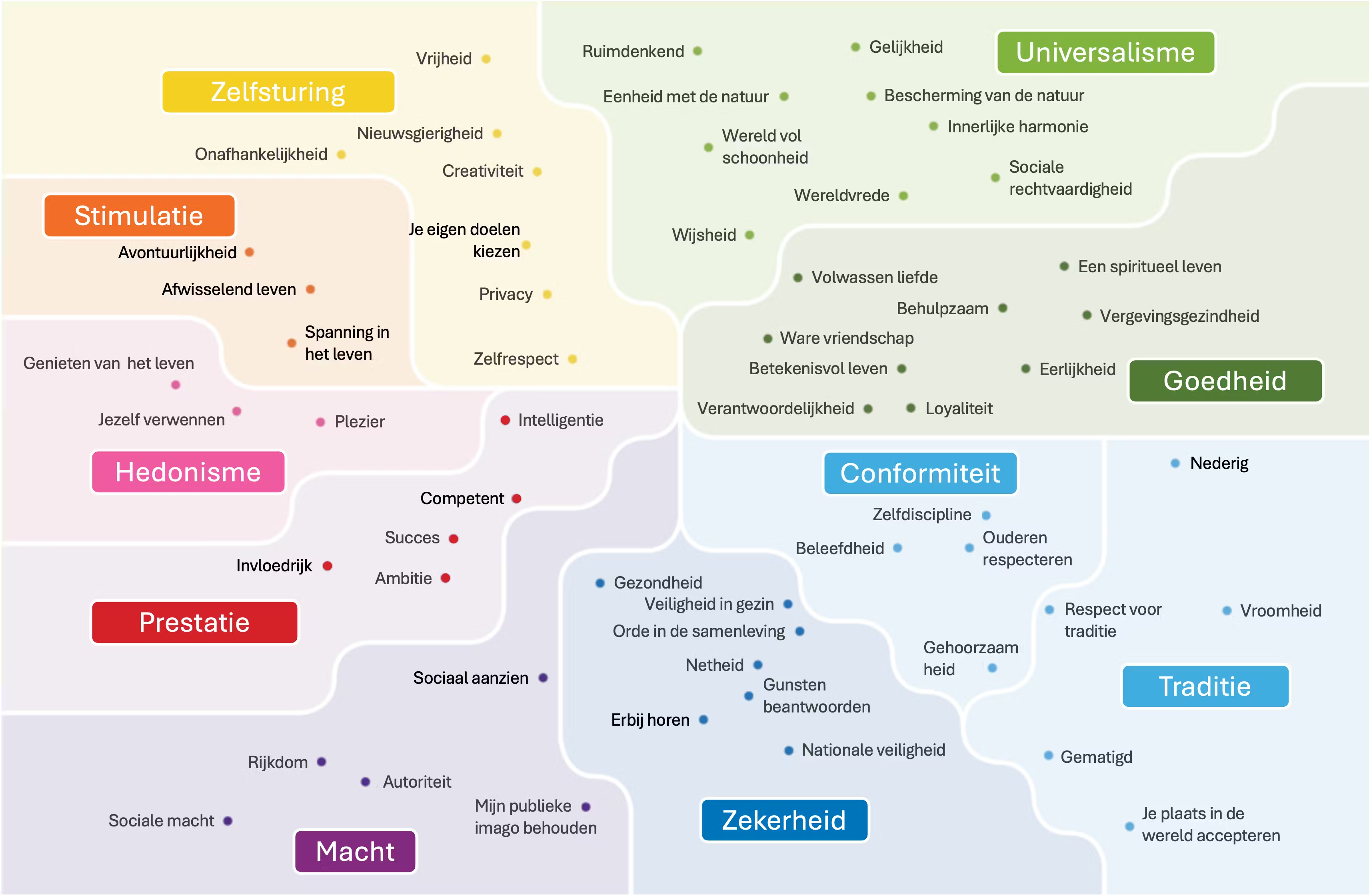
In 1992, the social psychologist Shalom Schwartz published a groundbreaking study. After years of cross-cultural research in 82 countries, he identified ten universal values that occur in people around the world: from safety and tradition to autonomy, performance, belonging, and fun.
We all carry those values within us. But we don't activate them all at the same time. Depending on the situation, the moment and the context, one value always comes to the fore.
And that's exactly where communication goes wrong so often.
Speaking from yourself instead of from your target group
As a communication maker, you almost always start from your own logic. Sustainability is important to you, so write about impact. You are convinced of the urgency, so speak to the sense of responsibility. But your target group may not be in that value at all at that time.
A concrete example: a seaside sign that warns of dangerous currents. The message starts from security - a completely logical choice. Alone, on a hot summer day, the people on that beach are mainly driven by pleasure. They want to enjoy themselves, not be warned. Result? The message goes through them.
It's not about the message. It's about the value that is currently present with your target group.
When it does work: a strong case
The Brazilian football club Sport Club do Recife shows how powerful it is if you do apply this principle. The club wanted to promote organ donation among its supporters - a topic that traditionally revolves around altruism and humanity. But altruism is an abstract value for many people, difficult to activate.
The club took a different approach: they spoke to fans on club love. “Keep your heart beating for your club.” By responding to connectedness - a value that is very current among football fans - the message did hit. The campaign, known as “Immortal Fans,” led to a massive increase in organ donor registrations.
Same goal. Different value. A world of difference.
Sustainable behavior comes in many flavors
What Schwartz's research also shows: people with different values can all behave sustainably - but each for a different reason. Someone drives an electric car because it's a status symbol. Another buys an energy-neutral home for her family's safety and comfort. And an influencer eats plant-based foods because of her healthy image.
None of them are primarily motivated by universalism or environmentalism. Nevertheless, they show the desired behavior. And if you make them aware of the sustainable impact of their choice, there can be a positive spillover effect: consistent behavior in line with who they want to be.
The question you should always ask as a communicator
Does your message start from your own logic? Or does it match what's currently happening with your target group? That is the core of value-driven communication. Do not manipulate, but connect. Understanding what value is currently active among the people you want to reach - and speaking from there.
Most messages are not missing because they are not correct in terms of content. They miss because they start from the transmitter instead of the receiver. That's what value-driven communication is all about. You don't start with what you want to say, you start with what the other person needs to move.
We shared this insight during the webinar 'The Psychology Behind Effective Communication' that we gave on April 1, together with our partners at Behavior Change Group. Do you want to continue working on this? On May 20 we are organizing an in-depth workshop in Antwerp.
Figure: Schwartz's circle of values (2006, p. 47). From the bottom left clockwise (in Dutch): power, performance, hedonism (pleasure), stimulation, self-direction, universalism, benevolence, conformism, tradition and safety.

.webp)